
Telepathy — Connecting Minds Beyond Words
Imagine a future where human beings can communicate thoughts directly from one mind to another—without speaking, typing, or using any external device. The concept of telepathy represents a world in which thoughts, emotions, intentions, and ideas could be shared instantly between people. Instead of trying to explain every feeling through words, one person could allow another to understand what is truly happening inside their mind.
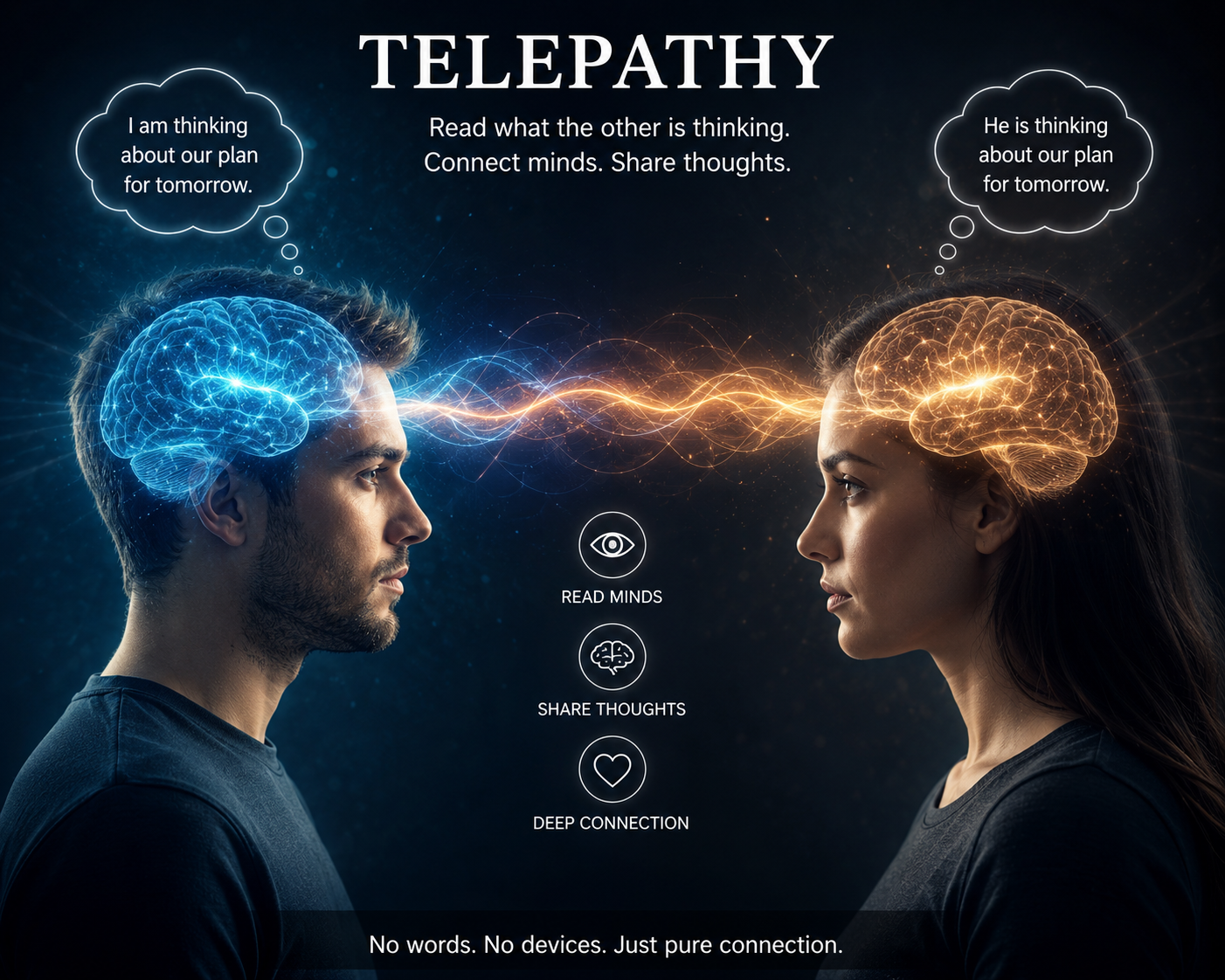
Such technology could create a completely new form of human communication. Two people planning something together might be able to share their ideas instantly, while family members could understand each other's feelings even when they are far apart. Misunderstandings caused by incomplete communication could potentially be reduced because people would be able to express not only their words but also the thoughts and emotions behind them.
Telepathy could also transform relationships and human connection. Imagine a husband and wife, parents and children, friends, or colleagues being able to communicate at a deeper level by sharing thoughts and emotions directly. A person who is unable to speak could potentially communicate through thoughts, while people separated by distance could experience a stronger sense of connection. Communication would become less dependent on language, geography, and physical limitations.
However, a technology capable of reading or sharing thoughts would also require enormous responsibility. Privacy, consent, security, and freedom of thought would have to be protected above everything else. No person should be able to access another person's thoughts without permission. The technology would need strong safeguards so that the ability to connect minds becomes a tool for understanding and cooperation rather than control or intrusion.
The ultimate vision of telepathy is therefore not simply to create a machine that can read minds, but to create a deeper form of human connection. No words. No devices. Just pure connection. If developed ethically and responsibly, such technology could help humanity understand one another more deeply, reduce misunderstandings, and move toward a future where communication is based not only on what we say, but also on what we genuinely think and feel.