
Universal Language Translation Device
Imagine a world where language is no longer a barrier between people. This device is designed as a real-time universal language translator, consisting of two wearable components: a smart earphone for understanding others and a smart mouth mask for communicating back. The user can select their preferred language through the device, and conversations can be translated instantly, allowing people from different countries and cultures to communicate naturally.
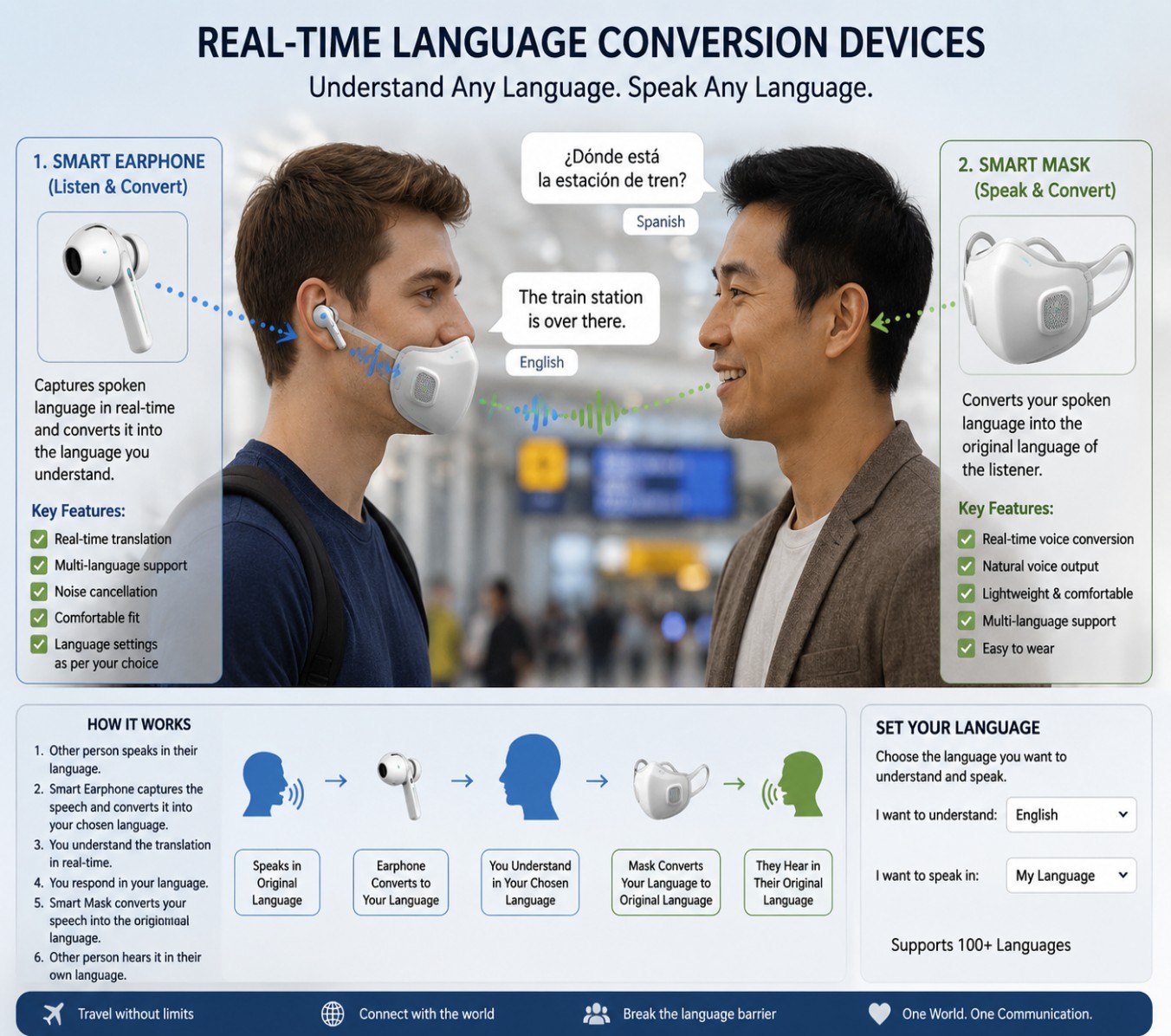
The smart earphone listens to the language spoken by another person and converts it into the language selected by the wearer. For example, if someone speaks Japanese and the wearer has selected English, the earphone can translate the Japanese speech into English so that the wearer can understand it. The system could potentially support a wide range of languages and dialects, making it useful for international travel, education, business meetings, tourism, healthcare, and everyday communication.
The second component is a smart translation mask worn over the mouth. When the wearer responds in their own language, the device converts the speech into the original language spoken by the other person. If the other person originally spoke Japanese and the wearer responds in English, the smart mask could convert the response into Japanese. In this way, both people can speak their own languages while understanding each other as though they were communicating in the same language.
The device could be designed with a simple language-selection system where users choose the language they want to understand and the language they want to speak. Artificial intelligence, speech recognition, machine translation, and voice-generation technologies could work together to provide near-real-time communication. Future versions could also recognize accents, regional expressions, background noise, and conversational context to make translations more natural and accurate.
Ultimately, this concept aims to create a world where everyone can communicate without having to learn every language. It could help travelers communicate with local people, enable businesses to work across international borders, help students learn from people around the world, and bring different cultures closer together. By reducing one of humanity's oldest communication barriers, a universal language-conversion device could contribute to a more connected and understanding world.