Brain Memory Reader & Recorder – Preserving Human Experiences
Imagine a future where the human brain can be read in a way that allows our memories and experiences to be digitally preserved. A Brain Memory Reader & Recorder could use advanced brain-scanning technologies and artificial intelligence to identify patterns associated with what a person sees, hears, feels, and remembers. Instead of memories disappearing with time, important experiences could potentially be converted into a digital format and stored securely for future access.
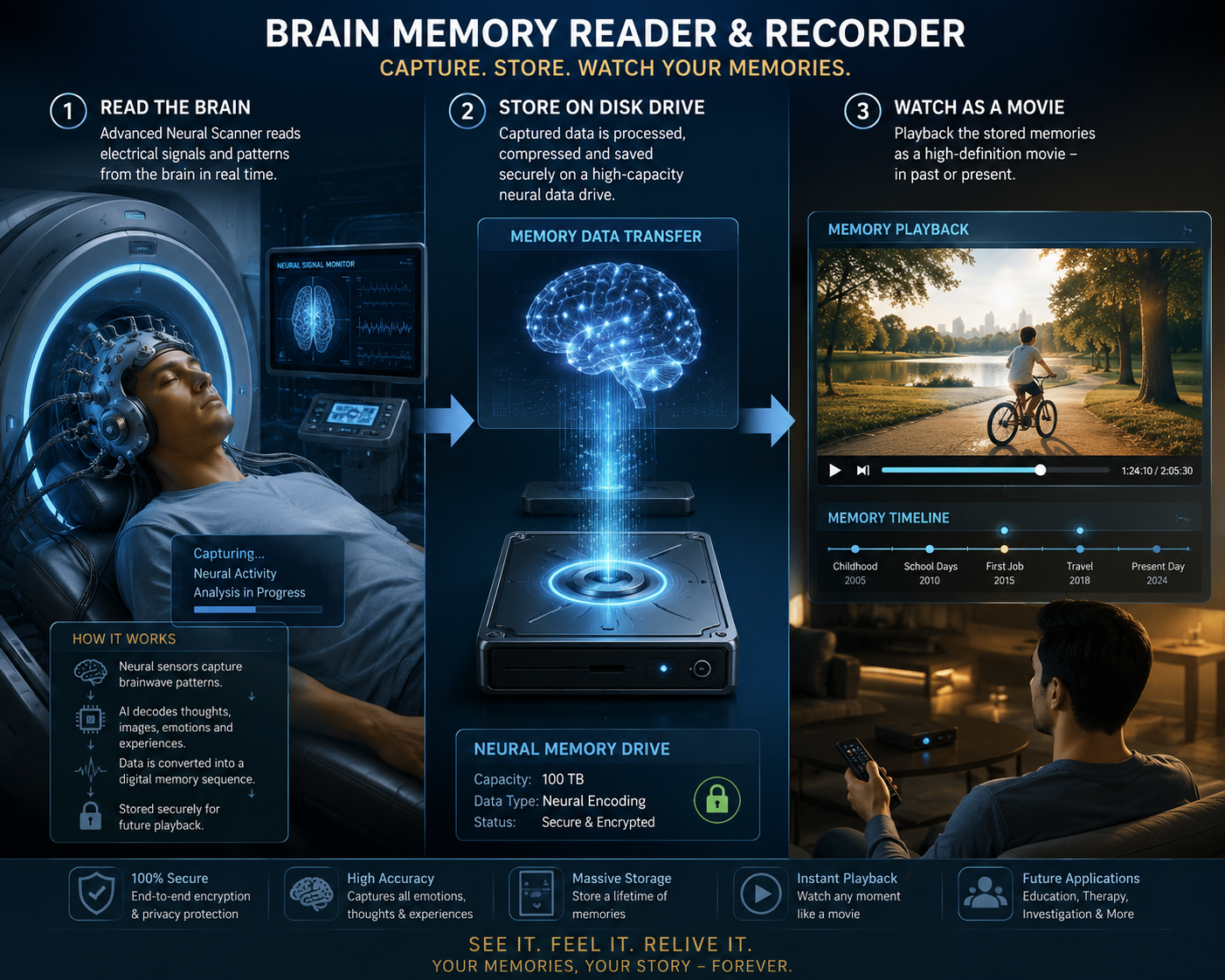
The basic concept would be to capture neural activity while a person is experiencing or recalling an event. Advanced sensors could record the brain's electrical and biological signals, while AI systems analyze these extremely complex patterns. The information could then be converted into a digital memory representation and stored on a high-capacity storage device. With further advances in neuroscience, brain-computer interfaces, and AI-generated reconstruction, the system could eventually attempt to recreate portions of a person's experiences in a visual and audio format.
Once stored, these digital memories could potentially be played back like a movie. A person might be able to revisit childhood experiences, remember important family moments, see places they visited many years ago, or review an experience that they have forgotten. The system could also potentially allow memories to be viewed from different perspectives or enhanced with additional information, creating an entirely new way of preserving personal history.
Such technology could have applications far beyond personal memories. In education, students could potentially learn from recorded experiences; in healthcare, carefully controlled memory representations might help researchers understand certain neurological conditions; and in historical preservation, people's firsthand experiences could become valuable records for future generations. It could even help families preserve stories and experiences of loved ones so that future generations can experience a small part of their lives.
However, making this vision a reality would require enormous scientific progress and extremely strong ethical safeguards. A person's memories would be among their most private forms of information, so ownership, consent, encryption, security, and control over access would have to be fundamental principles. The ultimate goal should not simply be to record the human brain, but to create a technology that allows humanity to preserve experiences, learn from the past, and keep precious memories alive—without compromising the dignity, freedom, and privacy of the individual.